
MIL-STD-461: CS106 / CS115 / CS116 GENERATORS
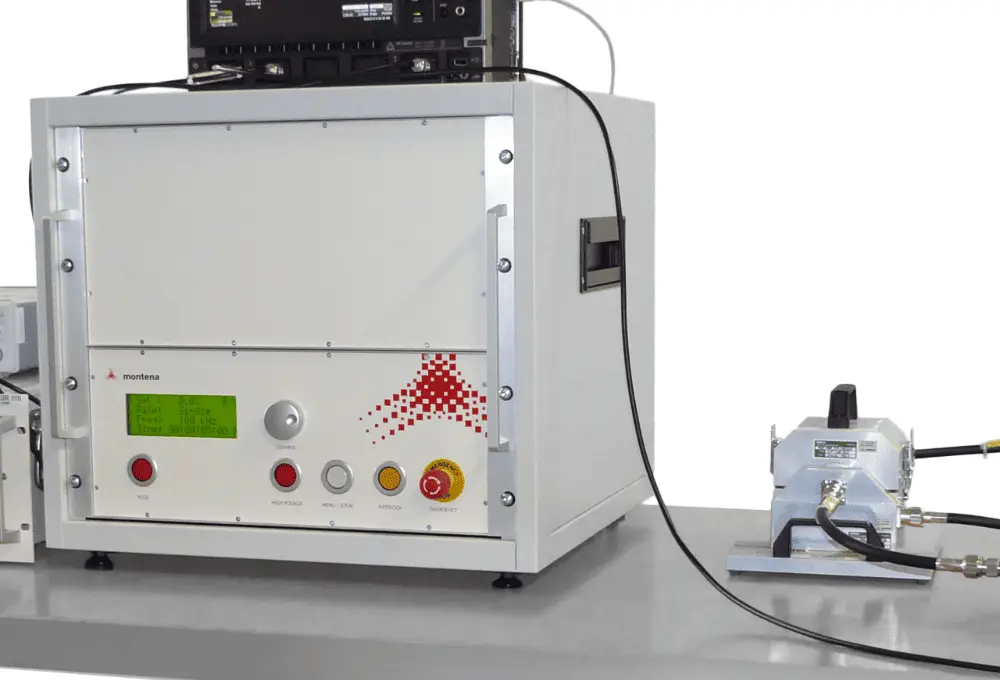
Montena develops and manufactures transient generators for conducted susceptibility tests according to the MIL-STD-461 CS115, CS116 and CS106 test methods.
Fast calibration, reduced testing time
Automatic generation of calibration and test reports
Expandable solution: can include CS114, CS115 and CS106
Used by more than 200 labs worldwide
CS116 GENERATOR
The CS116 requirement defines damped sine transients to be coupled onto the equipment under test at several frequencies in the range 10 kHz to 100 MHz to simulate events such as NEMP and lightning.
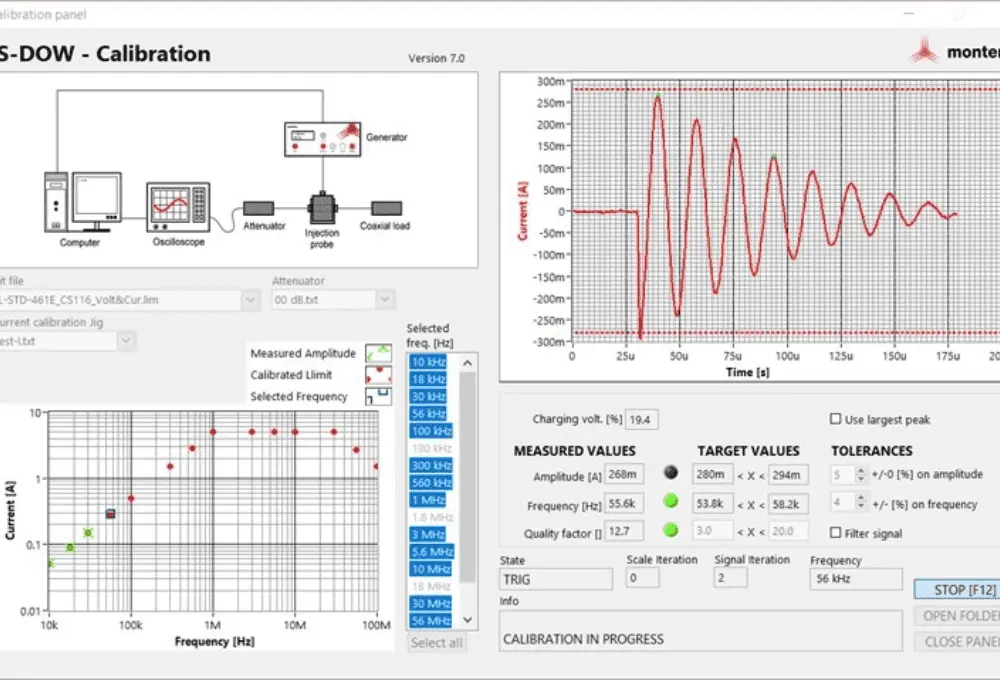
Montena POG-CS116 generator has a single signal output for all test frequencies. This allows the execution of all test frequencies without re-cabling or module exchange. The calibration phase is performed automatically in about a minute thanks to a dedicated control software. The generator is proposed with up to 17 test frequencies, to enable a better excitation of the resonances of the EUT.
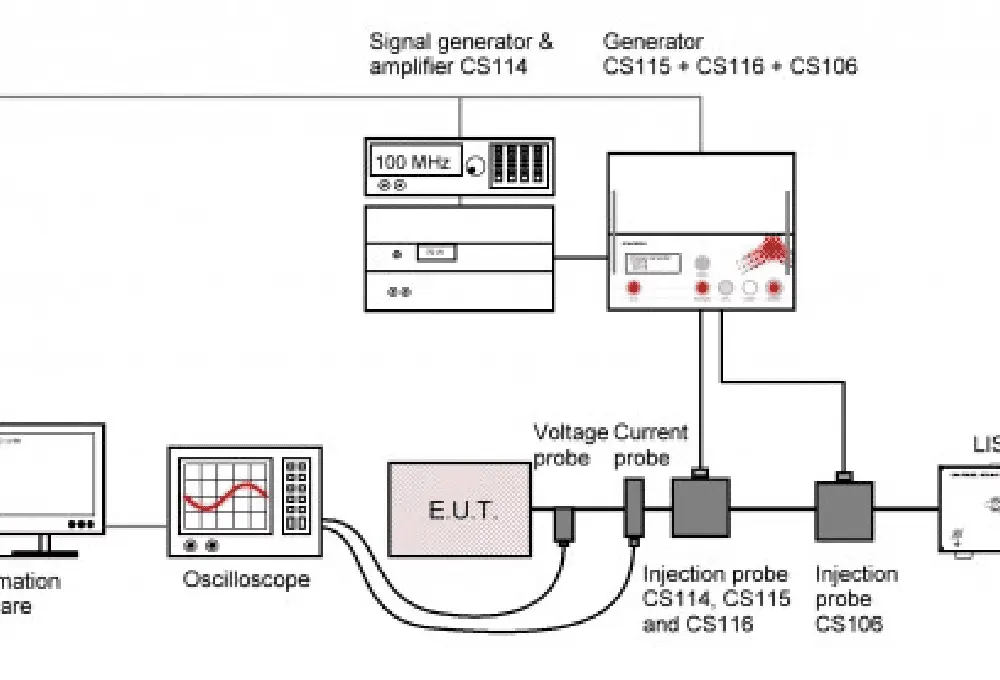
The POG-CS116 generator can host additional pulse modules for CS106 and CS115 pulse delivery beside the built-in CS116 modules. The CS115 and CS116 pulse modules are all connected to the same generator output.
CS115 GENERATOR
CS115 uses a fast trapezoidal pulse to excite natural resonances associated with cables. The basic concern is to protect equipment from fast rise and fall time transients that may be present due to platform switching operations and external transient environments such as lightning and electromagnetic pulses.
CS106 GENERATOR
CS115 uses a fast trapezoidal pulse to excite natural resonances associated with cables. The basic concern is to protect equipment from fast rise and fall time transients that may be present due to platform switching operations and external transient environments such as lightning and electromagnetic pulses.
DATASHEET & DOCUMENTATION
Access all technical data and resources about our conducted susceptibility generators and test systems and other EMC solutions.
Access detailed specifications
Make informed, confident choices
Contact us for further assistance
FAQ
This product page covers three MIL-STD-461 conducted susceptibility test methods. CS106 tests the ability of AC and DC input power leads of submarine and surface ship equipment to withstand transient voltage spikes. CS115 tests the ability of interconnecting cables to withstand fast rectangular pulse excitation. CS116 tests the ability of interconnecting cables to withstand damped sinusoidal excitation across a range of discrete frequencies from 10 kHz to 100 MHz. Each method targets a different waveform type and cable category, and all three are available as standalone generators or as plug-in modules for the POG-CS116 modular platform.
The PG-CS106 generator is designed for transient conducted susceptibility testing of AC and DC input power leads in accordance with MIL-STD-461F CS106, specifically applicable to submarine and surface ship equipment. The aim of the test is to verify the ability of the EUT to withstand transients coupled onto input power leads.
The setup delivers a voltage pules of to 500 V, with a rise time of 1.5 µs ± 0.5 µs and a pulse duration of 5 µs ± 22% (both measured on a 5 Ω load), with an output impedance of ≤ 2 Ω.
The active inductive coupler IC10M s used for correct injection onto power leads. It is not necessary to open the power lead under test.
The generator is remote controllable via RS232 and USB interfaces and is also available as a compact module (M-CS106) for integration into the POG-CS116 modular enclosure.
A dedicated Windows-based control software (SW-CS115) is available.
The PG-CS115 generator is designed for conducted susceptibility testing of interconnecting cables in accordance with MIL-STD-461 D/E/F/G/H CS115. The aim of the test is to verify the ability of the EUT to withstand impulse signals coupled onto the EUT associated cabling.
The setup delivers a rectangular pulse with a rise and fall time of ≤ 2 ns (10–90%), a pulse duration of ≥ 30 ns (90–90%), and a maximum output voltage of approximately 1 kV on a 50 Ω load. The repetition rate is adjustable from single shot to 50 Hz.
The test setup utilizes an inductive injection probe for correct injection onto the cable bundles under test.
The generator is remote controllable via RS232 and USB interfaces and is also available as a compact module (M-CS115) for the POG-CS116 platform.
A dedicated Windows-based control software (SW-CS115) is available.
The POG-CS116 generator is designed for conducted susceptibility testing of interconnecting cables using a damped oscillatory waveform, in accordance with MIL-STD-461 D/E/F/G/H CS116. The aim of the test is to verify the ability of the EUT to withstand damped sinusoidal transients coupled onto EUT associated cables and power leads.
The setup delivers a damped sinusoidal output of 10 A on 100 Ω with a damping factor of 15 ± 5 and an output impedance of < 100 Ω. Three variants are available depending on the number of discrete test frequencies required: the POG-CS116-6 covers the 6 standard MIL-STD-461 frequencies (10 kHz, 100 kHz, 1, 10, 30, 100 MHz); the POG-CS116-9 adds intermediate frequencies for improved resonance excitation; and the POG-CS116-17 covers 17 frequencies from 10 kHz to 100 MHz for the most thorough characterization of EUT resonances. All variants use a single output connection, eliminating the need for reconnection between frequencies and enabling fully automated test sequences.
The test setup utilizes an inductive injection probe for correct injection onto the cables under test.
The generator is remote controllable via RS232 and USB interfaces.
A dedicated Windows-based control software (SW-CSDOW) is available.
The CS116 test method is designed to excite resonances in the equipment under test (EUT) and its interconnecting cables. MIL STD requires at least 6 basis test frequencies. It also specifies that if there are other frequencies known such as platform resonances, compliance shall also be demonstrated at those frequencies. Since such resonance frequencies are not always predictable and depend on the specific cable lengths, connector configurations, and circuit impedances of the EUT, testing at only the 6 standard frequencies may miss significant resonances that fall between them. Expanding to 9 or 17 test frequencies provides a finer resolution, closer to the possible relevant platform resonances, resulting in a more thorough and reliable immunity assessment.
Yes. Both the CS106 and CS115 generators are available as plug-in modules (M-CS106 and M-CS115) designed for installation inside the POG-CS116 modular 19″ rack enclosure. This integration allows a single rack to cover all three conducted susceptibility test methods (CS106, CS115, and CS116), reducing bench space and simplifying cable management and test workflow.
The recommended IPDR250 injection probe (frequency range 10 kHz – 400 MHz, internal diameter 43.8 mm) is compatible with CS114, CS115, and CS116 tests and is used with the CJDR250 calibration jig. For CS116, the SW-CS-DOW Windows-based software application controls the generator, performs automated calibration to standard or user-defined injection levels, manages the test sequence across all selected frequencies, and generates calibration and test reports. For CS115, the SW-CS115 software provides equivalent functionality. For CS106, the active inductive coupler IC10M is mandatory and must be ordered with the generator.
The table below summarizes the key technical specifications of the CS106, CS115, and CS116 generators:
| Parameter | CS106 (PG-CS106) | CS115 (PG-CS115) | CS116 (POG-CS116) |
|---|---|---|---|
| Standard | MIL-STD-461F CS106 | MIL-STD-461 D/E/F/G/H CS115 | MIL-STD-461 D/E/F/G/H CS116 |
| Application | Power leads (AC/DC) – submarine & surface ships | Interconnecting cables – pulse excitation | Interconnecting cables – damped sinusoidal excitation |
| Output waveform | Damped transient pulse | Rectangular pulse | Damped oscillatory wave |
| Peak output | 8 – 100 A (peak current), up to 500 V internal | ~1 kV on 50 Ω | 10 A on 100 Ω |
| Rise time | 1.5 µs ± 0.5 µs (0–100%, on 5 Ω) | ≤ 2 ns (10–90%) | — |
| Pulse duration | 5 µs ± 22% (0–0%, on 5 Ω) | ≥ 30 ns (90–90%) | — |
| Output impedance | ≤ 2 Ω | 50 Ω | < 100 Ω |
| Test frequencies | — | — | 6, 9, or 17 discrete frequencies (10 kHz – 100 MHz) |
| Repetition rate | Single, 1 – 15 Hz | Single, 1 – 50 Hz | Single, 0.5 Hz, 1 Hz |
| Output connector | Hummel M23 | N (f), 50 Ω | N (f), 50 Ω |
| Control interface | RS232, USB | RS232, USB | RS232, USB |
| Power supply | 90–264 Vac, 150 VA | 90–264 Vac, 150 VA | 90–250 Vac, 75 VA |
| Weight (standalone) | 13 kg | 13.5 kg | 17 kg (19″ rack only) |
| Module version available | Yes (M-CS106, 1.2 kg) | Yes (M-CS115, 1.2 kg) | N/A – base unit |
PROJECT? QUESTION?
Contact our team to explore the potential of Montena’s innovative solutions to achieve your challenging goals.
NEWSROOM
Stay in sync with the pulse of your industry—get insights, product updates, and expert perspectives delivered right here.