
HELICOPTER 300KV ESD TEST SYSTEM
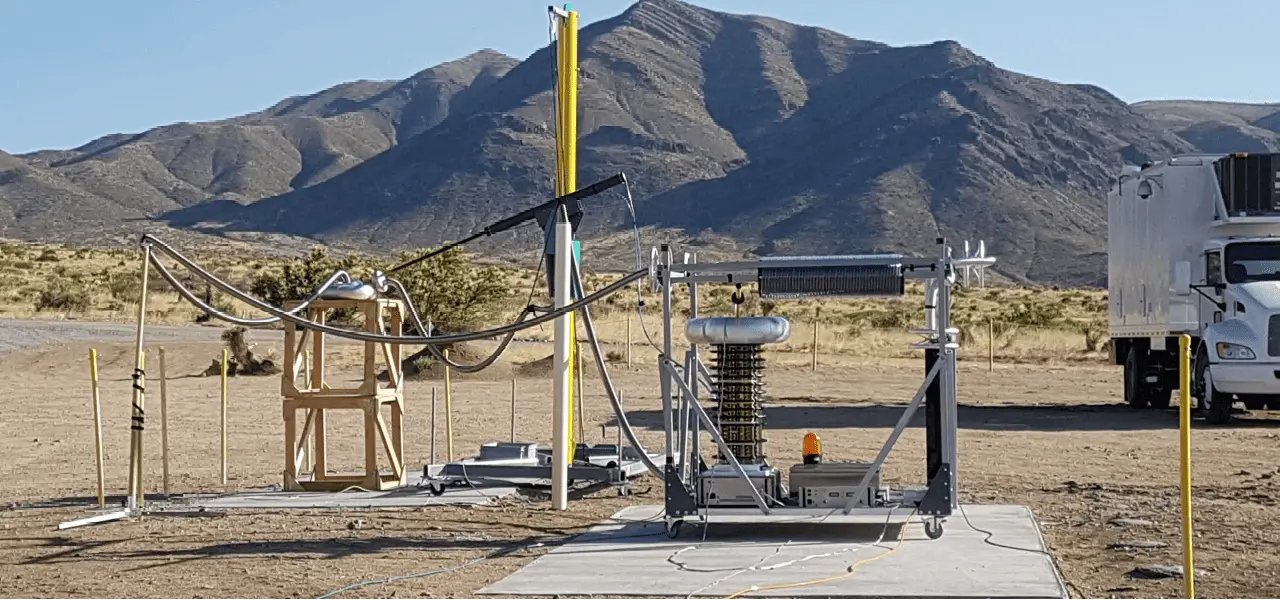
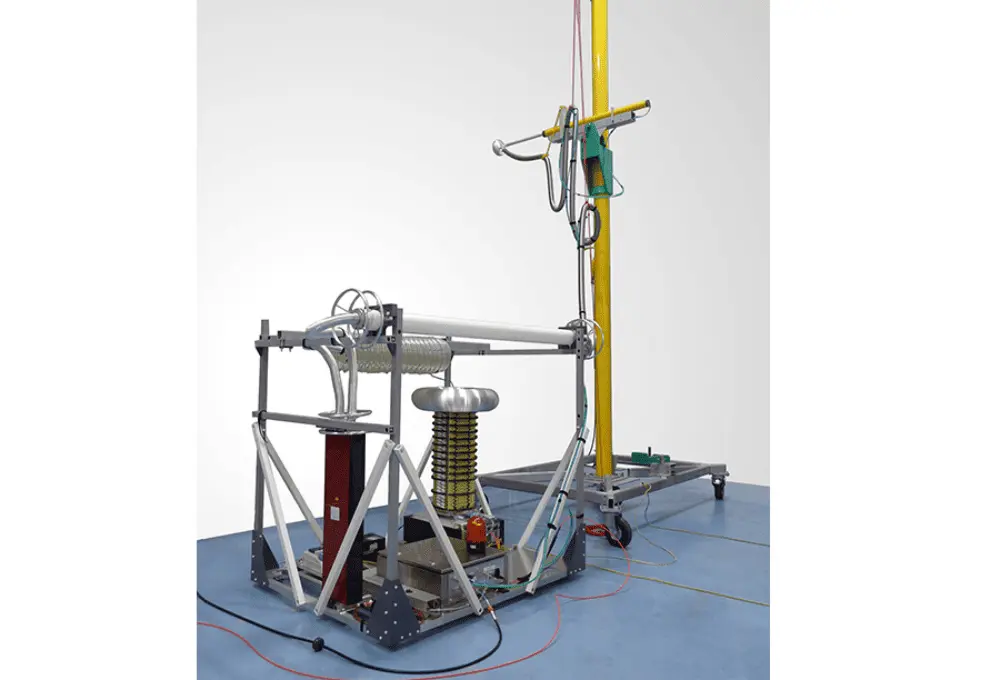
Montena’s advanced test system generates electrostatic discharges up to 300 kV to enhance safety and reliability during critical helicopters and aircraft operations
Electrode adjustable in height (from 1 to 6 meters) and angle ( ± 60°)
Remote controlled operation for hazardous tests
Positive and negative polarity available
Pulse current measurement
Helicopters and aircrafts can electrically charge by flying through the air and colliding with dust, rain or snow. Discharges of a few hundreds of kilovolts can occur between the aircraft and the ground during landing or hoisting, or even between aircrafts during inflight refueling.
We developed a test system that produces electrostatic discharges (ESD) up to 300 kV, to conduct Personnel-borne Electrostatic Discharge (PESD) and Helicopter-borne ESD (HESD) tests according to MIL-STD-331, MIL-STD-464, NATO AECTP-250 leaflet 253 or NATO AECTP 500 leaflet 508. The system is built on two separate carts, with the discharge electrode mounted on a height- and tilt- adjustable pneumatic piston.
DATASHEET & DOCUMENTATION
Access all technical data and resources about our ESD generators and systems and other EMC solutions.
Access detailed specifications
Make informed, confident choices
Contact us for further assistance
FAQ
The PGESD300K-DP is designed to perform high-voltage electrostatic discharge (ESD) tests up to 300 kV on helicopter-borne equipment and airborne systems, for most requirements of MIL-STD-331 C/D (fuse and fuse component environmental and performance tests, Appendix F), NATO AECTP 250 (leaflet 253), NATO AECTP 500 (leaflet 508), MIL-STD-464, JOTP-062, and DEF STAN 59-411 Part 2. It is applicable to situations where helicopters accumulate significant electrostatic charge during flight — particularly in dry or dusty environments — and where the resulting discharge upon landing or personnel contact can endanger crew, damage equipment, or initiate electro-explosive devices.
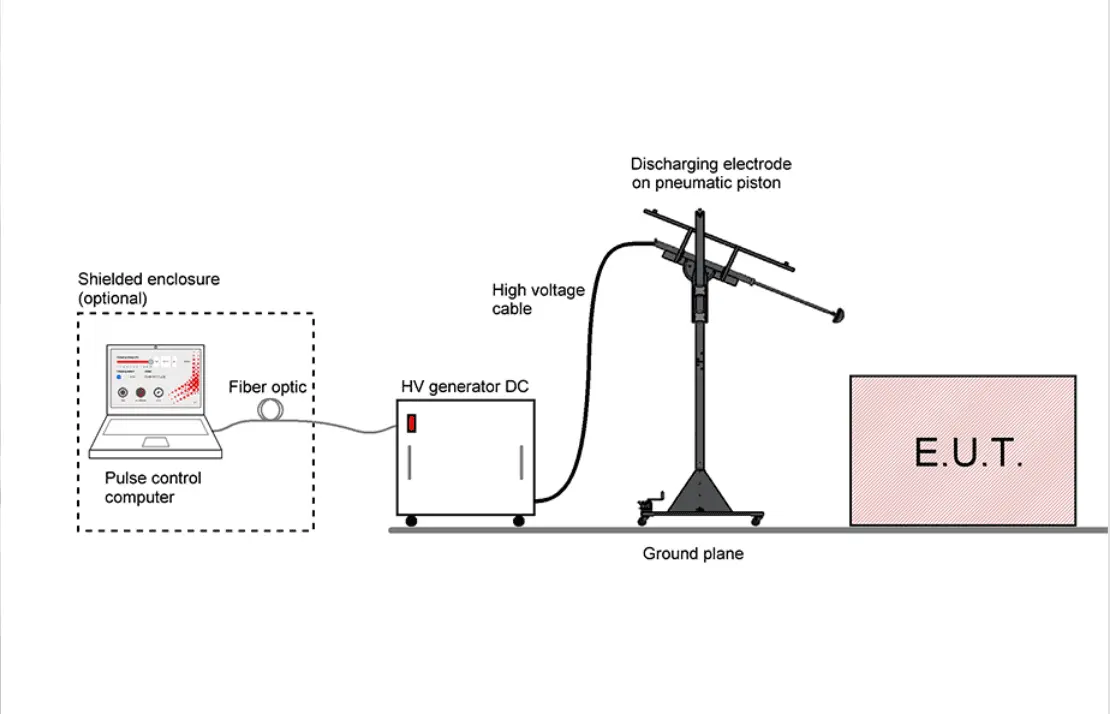
The system supports three distinct test configurations. In the first configuration, a charged electrode is discharged to a grounded equipment under test (EUT), simulating a discharge from the airframe or rotor to a ground-referenced component.
In the second configuration, the EUT is charged and subsequently discharged to a grounded electrode, simulating the discharge of a charged aircraft system to a ground reference.
In the third configuration — the high voltage corona (P-static) test which requires an optional 250 MΩ resistor — a sustained corona current is applied to the EUT to simulate the effects of precipitation static charging conditions encountered during flight. These conditions can generate broadband RF interference and degrade the performance of communication, navigation and other sensitive electronic systems.
The PGESD300K-DP charges a 1 nF ± 10 % capacitor to a nominal voltage of 300 kV ± 5 %, with an adjustable range from a few kilovolts to 300 kV and reversible polarity. The output impedance is below 1 Ω and the total circuit inductance is approximately 7.5 µH, resulting in a short circuit current exceeding 2 kA with a 3.5 m ground return wire. The maximum DC charging current is 20 mA and it is adjustable. An arcing detection stops the high voltage power supply.
In our approaching probe method, the discharge electrode is mounted on a pneumatically actuated moving arm controlled remotely by the system’s control unit. The electrode can be oriented in many directions to reach specific points on the EUT. Two mast configurations are available: the ESD-MAST-2M, a movable stand on wheels offering electrode height adjustment from 0.5 to 2 m, and the ESD-MAST-6M, a movable mast on wheels for larger systems offering height adjustment from 1.5 to 4 m or, with the extension, to 6 m. The electrode tip travel distance is 1 m. The pneumatic actuation requires a minimum air supply of 20 litres at 6 bar.
Operator safety is ensured through complete electrical isolation between the control station and the high-voltage test setup. The system is controlled via a web-based software application communicating through a USB optical extender — a fibre optic link — which eliminates any conductive path between the operator and the generator or electrode. The discharge current pulse is monitored by an embedded oscilloscope. The automatic protection circuit further reduces operator risk by continuously monitoring for arc and overload conditions and reducing the output voltage accordingly.
A full range of accessories is available: the ESDR100-300K (100 Ω, 300 kV calibration test load), the ESDR250M (250 MΩ serial resistor for the MIL-STD-331D high voltage corona test), the ESDR500-300K (500 Ω serial resistor for NATO STANAG 4235 testing, installed on the generator output), the FT300K (300 kV wall feedthrough for indoor-outdoor installation of the test setup), and the SB3G shielded enclosure (10 kHz to 3 GHz) for the protection of additional measurement instruments in the electromagnetic environment generated during testing.
The table below provides the complete technical specifications of the system:
| Parameter | PGESD300K-DP |
|---|---|
| Standards | MIL-STD-331 C/D, NATO AECTP 250 (leaflet 253), NATO AECTP 500 (leaflet 508), MIL-STD-464, JOTP-062, DEF STAN 59-411 Part 2 |
| Nominal charging voltage | 300 kV ± 5 % |
| Voltage range | a few kilovolts to 300 kV, reversible polarity |
| Maximum charging current | 20 mA |
| Capacitor | 1 nF ± 10 % |
| Output impedance | < 1 Ω |
| Total inductance | ~7.5 µH |
| Short circuit current | > 2 kA (with 3.5 m ground return wire) |
| Electrode height – 2 m mast | 0.5 – 2 m (adjustable) |
| Electrode height – 6 m mast | 1.5 – 4 m or, with extension, to 6 m (adjustable) |
| Electrode tip travel distance | 1 m |
| Remote control | Web-based application |
| Control interface | USB optical extender (fibre optic isolation) |
| Power supply | 3-phase 400 Vac ± 10 % / 16 A (option: 208 Vac / 20 A), 48–63 Hz, 6 kW peak |
| Air compressor requirement | Minimum 20 litres / 6 bar |
| Generator unit dimensions (W × L × H) | 155 × 250 × 195 cm / 223 kg |
| 2 m mast & stand dimensions | 134 × 160 × 210 cm / 111 kg |
| 6 m mast & stand dimensions | 180 × 290 × 635 cm / 480 kg |
| Operating temperature | 15 – 40 °C |
PROJECT? QUESTION?
Contact our team to explore the potential of Montena’s innovative solutions to achieve your challenging goals.
NEWSROOM
Stay in sync with the pulse of your industry—get insights, product updates, and expert perspectives delivered right here.