
GHZ BROADBAND OPTICAL LINK (RF OVER FIBRE)
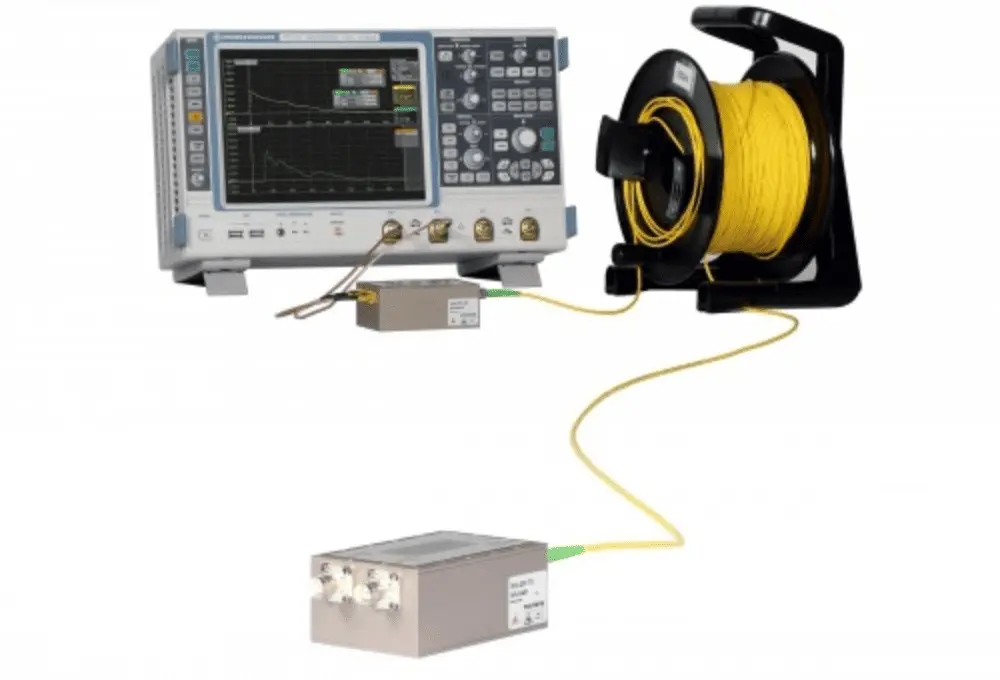
Take advantage of fibre-optic systems, designed for high-quality transmissions, even over long distance or in harsh electromagnetic environments
Unsurpassed immunity to electromagnetic fields
> 40 hours autonomy on batteries (standby >10 days)
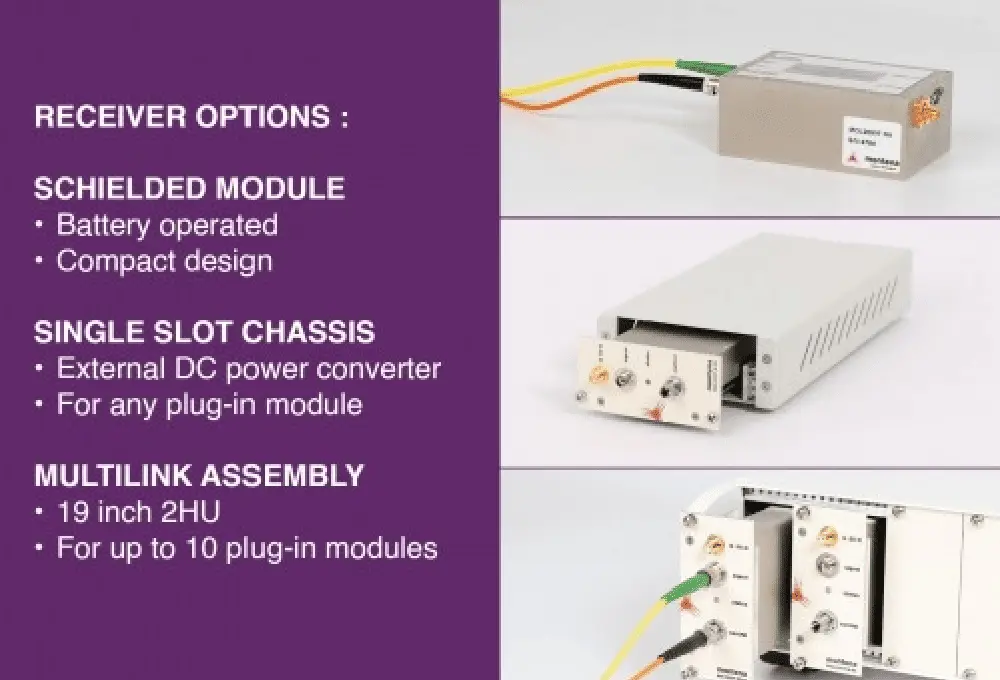
Battery powered point-to-point modules, or up to 10 slot chassis with plugin modules
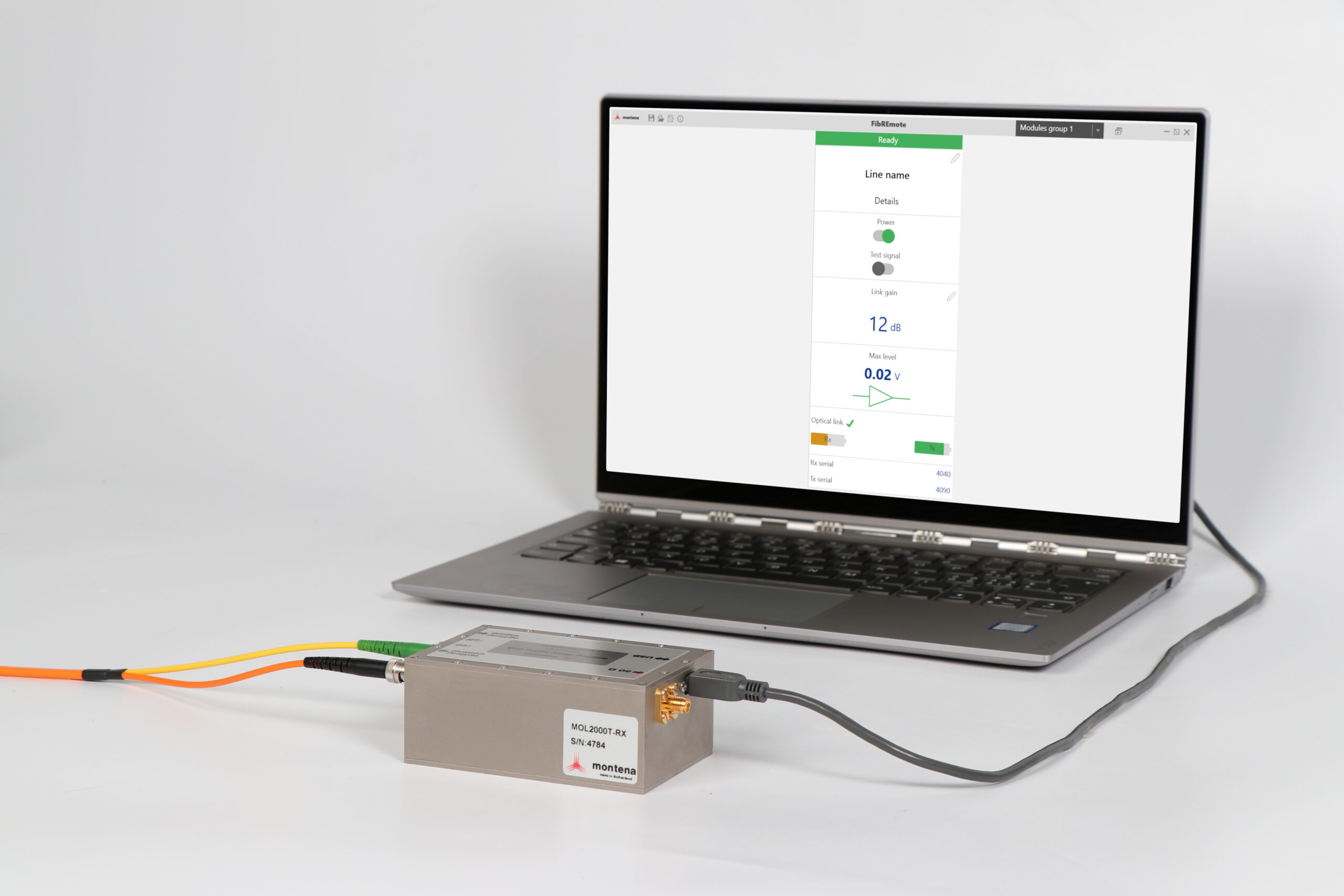
Remotely selectable transmission gain
Optical fiber cable provides total galvanic isolation
We design fiber-optic transmission systems to ensure high-quality transmissions of analog signals from 80 Hz up to 3.5 GHz over long distances or in harsh electromagnetic environments.
The compact, highly shielded electro-optical conversion module is particularly well suited to measurements in high-power electromagnetic testing applications.
In the point-to-point version, both the optical transmitter and receiver modules are battery-powered. In the point-to-frame version, the plug-in receiver modules are inserted in a 1- or 10-slot frame and are powered from the frame. Different models of MOL can be mixed in the same chassis.
The MOL3000 has a fix transmission gain of 0 dB, while the MOL2000T has a remotely selectable transmission gain from -62 dB to +24 dB.
DATASHEET & DOCUMENTATION
Access all technical data and resources about our fiber optic links and other measurement tools and software.
Access detailed specifications
Make informed, confident choices
Contact us for further assistance
FAQ
An RF over Fiber (RFoF) broadband optical link is a system that converts an analog RF signal into an optical signal, transmits it through a fiber optic cable, and then converts it back into an electrical RF signal. This technology allows wideband RF signals to be transmitted over long distances while maintaining signal integrity.
Montena’s GHz broadband optical links are part of the Modular Optical Link (MOL) family, designed to ensure reliable signal transmission even in demanding electromagnetic environments. They are commonly used in high-voltage measurement systems, electromagnetic testing setups, and laboratory environments where electrical isolation and immunity to electromagnetic interference are critical.
Compared with traditional coaxial cables, RF over Fiber transmission offers significant advantages for measurement systems. Fiber optics provide:
- Complete galvanic isolation between the measurement point and the acquisition equipment
- Very low optical attenuation over long distances
- High immunity to electromagnetic interference (EMI)
- No ground loop issues in sensitive setups
Montena’s GHz broadband optical links are therefore particularly suited for high-field environments, high-voltage experiments, and remote measurement systems.
Montena’s GHz broadband optical link is designed to support a wide frequency range, typically from 80 Hz up to 3.5 GHz. This wide bandwidth enables the accurate transmission of fast transient signals and high-frequency RF signals, making the system well suited for RF measurements, electromagnetic pulse (EMP) testing, and high-speed signal monitoring.
Different models within the MOL family, such as the MOL2000T and MOL3000, are optimized to ensure stable and reliable broadband signal transmission across this frequency range.
Montena’s RF over Fiber technology provides several key advantages for demanding measurement environments:
- Wide bandwidth up to 3.5 GHz for high-frequency RF signals
- Exceptional immunity to electromagnetic interference
- Full galvanic isolation between measurement equipment
- Stable signal transmission over long distances using optical fiber
- Compact, shielded transmitter and receiver modules
The transmitter and receiver modules are also battery-powered, providing more than 40 hours of autonomy, which allows flexible deployment in laboratories or remote testing environments.
These advantages make Montena fiber-optic RF links a reliable solution for advanced measurement and testing applications.
Montena’s broadband optical links offer flexible deployment options depending on the measurement setup, and can be used in:
- Standalone point-to-point configurations, with a transmitter and receiver connected through an optical fiber
- Modular chassis configurations, where multiple receiver modules can be integrated into a dedicated frame
This modular architecture allows engineers to adapt the system to complex measurement environments while maintaining high signal integrity.
Both systems belong to Montena’s fiber-optic measurement solutions, but they are designed for different types of signals and measurement environments.
The GHz Broadband Optical Link (RF over Fiber) is designed for wideband RF signal transmission, supporting frequencies from 80 Hz up to 3.5 GHz. It is typically used for RF measurements, electromagnetic testing, and fast signal monitoring. MOL2000T and MOL3000 belong to this product range.
The MHz Broadband Optical Link – Isolated Probe is optimized for precision electrical measurements, supporting signals from DC up to tens or hundreds of MHz. It is particularly suited for voltage measurements in high-voltage or floating potential environments. MOL500T and MOL25T belong to this product range.
WE RECOMMEND ALONGSIDE:
USED IN APPLICATION
Learn how our technology and solutions are applied in concrete scenarios and how they can benefit your organization.
PROJECT? QUESTION?
Contact our team to explore the potential of Montena’s innovative solutions to achieve your challenging goals.
NEWSROOM
Stay in sync with the pulse of your industry—get insights, product updates, and expert perspectives delivered right here.