
V-DOT VOLTAGE SENSORS
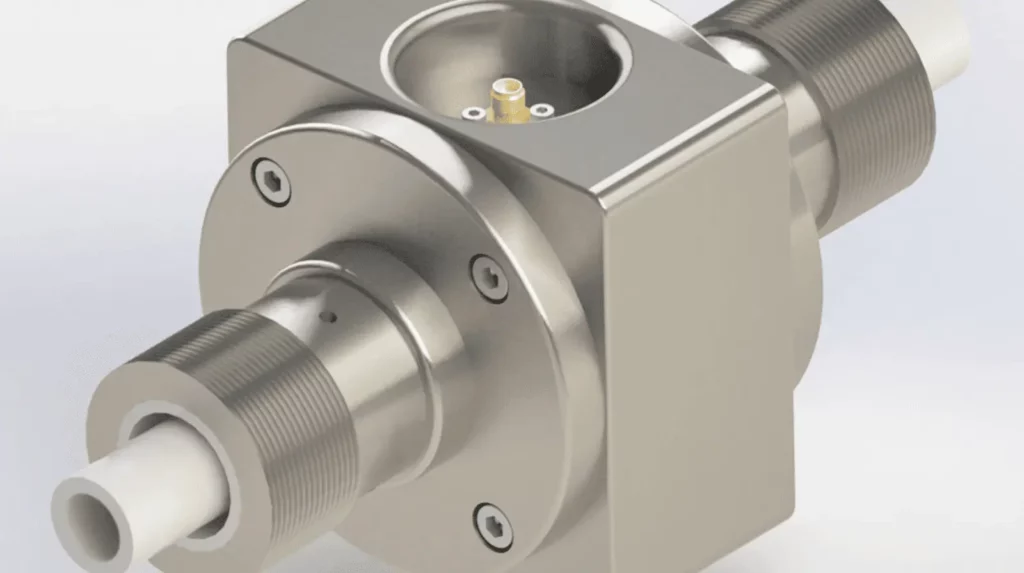
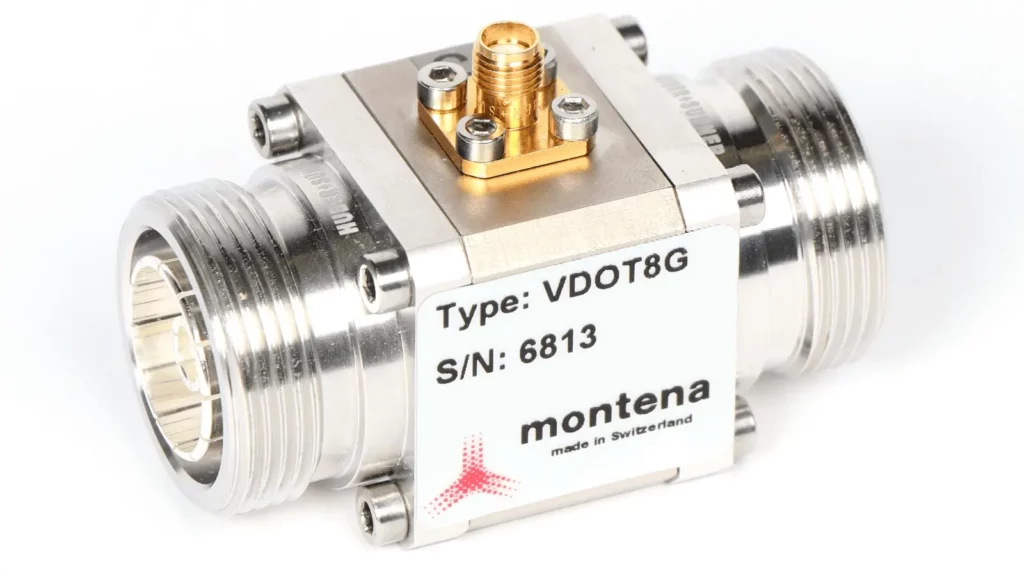
Stay ahead of the curve — discover the reliability of Swiss precision with our V-Dot voltage sensors, engineered to provide real-time, accurate measurements of fast and high-voltage transients.
Able to measure high voltage nanosecond pulses
Models available up to 200 kV
Very low insertion loss
High robustness
Our V-Dot voltage sensors deliver an output signal proportional to the variation of the voltage in a coaxial feed through connector. They are used for real time measurement of fast and high voltage transients.
The output electrical signal shall be integrated to recover the measured voltage transient. This can either be done by one of Montena’s passive integrators, or by means of a mathematical integration.
To make your operations more efficient, Montena has the right solution. Try our PULSELab software application. It has been specifically developed to ease the measurement of transients with derivative sensors. It even includes that numerical integration capability.
DATASHEET & DOCUMENTATION
Access all technical data and resources about our derivative sensors and integrators, and other measurement tools and software.
Access detailed specifications
Make informed, confident choices
Contact us for further assistance
FAQ
A V-dot voltage sensor is a derivative sensor designed to measure the rate of change of voltage over time (dV/dt) rather than the absolute voltage level. The sensor produces an output signal proportional to the time derivative of the voltage, which can then be integrated to reconstruct the original waveform. V-dot sensors are widely used in high-voltage and fast transient environments where conventional voltage probes cannot operate safely or accurately. Their non-intrusive design allows measurements without direct electrical contact with the conductor. They are particularly effective for pulsed power systems, electromagnetic compatibility testing, lightning studies, and high-voltage switching measurements, where voltage transitions occur extremely rapidly.
A V-dot sensor operates based on capacitive coupling. When placed near a conductor carrying a rapidly changing voltage, the electric field induces a current in the sensor proportional to the derivative of the voltage. Because the raw output represents dV/dt, the signal must pass through an integrator to reconstruct the original voltage waveform. This approach enables highly accurate measurements of very fast voltage transients.
This principle allows the sensor to operate with minimal loading of the circuit, ensuring that the measurement does not disturb the system under test. This makes V-dot sensors particularly suitable for high-speed pulsed systems and electromagnetic test setups.
V-dot sensors offer several advantages when measuring fast voltage transients. Their design allows them to capture signals with extremely high bandwidth, which is essential when analyzing nanosecond or sub-nanosecond events. Because they rely on capacitive coupling, they are electrically isolated from the measured conductor, reducing safety risks and eliminating the need for direct connections in high-voltage environments.
Another key benefit is their minimal influence on the measured circuit. Traditional probes can introduce capacitance or resistance that alters the signal, while V-dot sensors provide a far more non-intrusive measurement method.
These properties make them ideal for pulsed power research, electromagnetic testing, lightning simulation, and high-voltage switching diagnostics.
V-dot voltage sensors are commonly used in environments where fast voltage changes and extreme electromagnetic conditions occur.
Typical applications include pulsed power systems, high-voltage switching experiments, lightning impulse testing, electromagnetic compatibility (EMC) measurements, and defense or aerospace research.
They are also valuable in laboratories studying electromagnetic pulse (EMP) effects, where accurate measurement of extremely fast voltage transients is required.
In industrial environments, V-dot sensors help engineers diagnose switching phenomena, validate insulation systems, and analyze transient overvoltages.
Their combination of high bandwidth, electrical isolation, and robustness makes them an essential tool for measuring fast electrical phenomena in demanding environments.
Montena V-dot sensors are specifically designed for high-performance measurements in harsh electromagnetic environments.
They combine wide bandwidth, high sensitivity, and excellent signal fidelity. This allows engineers and researchers to capture extremely fast voltage transients with precision.
The sensors are built using robust materials and optimized geometries to ensure reliable operation even in the presence of strong electromagnetic fields or high-voltage pulses.
Another advantage is their compatibility with dedicated integrators, enabling accurate reconstruction of voltage waveforms for analysis.
These characteristics make Montena V-dot sensors particularly suitable for advanced research laboratories, pulsed power facilities, and high-voltage testing environments.
WE RECOMMEND ALONGSIDE:
USED IN APPLICATION
Learn how our technology and solutions are applied in concrete scenarios and how they can benefit your organization.
PROJECT? QUESTION?
Contact our team to explore the potential of Montena’s innovative solutions to achieve your challenging goals.
NEWSROOM
Stay in sync with the pulse of your industry—get insights, product updates, and expert perspectives delivered right here.